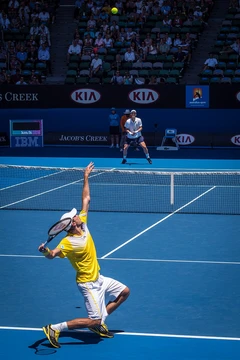
Roy Emerson
Australian amateur tennis great with record 28 major titles.
Roy Stanley Emerson (born 3 November 1936) is an Australian former tennis player who holds the all-time record for a male player with 28 Grand Slam titles—12 in singles and 16 in doubles. All of his singles majors and 14 of his doubles majors came before the Open era started in 1968. He is the only man to achieve a career Grand Slam in both singles and doubles, and he was the first of four men (alongside Rod Laver, Novak Djokovic, and Rafael Nadal) to complete a double career Grand Slam in singles.
Emerson was born on a farm in Blackbutt, Queensland, and later moved to Brisbane, where he attended Brisbane Grammar School and Ipswich Grammar School and received better tennis instruction. He played his first singles tour event at the 1951 Southwest Queensland Championships and won his first singles title at the 1953 Queensland Hard Court Championships. His first Grand Slam doubles title came in 1959 at Wimbledon with Neale Fraser. In 1961, he won his first Grand Slam singles title at the Australian Championships, beating Rod Laver in four sets, and later that year claimed the US Championships, again defeating Laver.
Known as "Emmo," the six-foot right-hander was a serve-and-volley player who trained hard and maintained exceptional fitness, adapting to slow courts and all surfaces. From 1963 to 1967, he won five consecutive Australian Championships singles titles, and his six Australian men's singles crowns stood as a record until Novak Djokovic won his seventh in 2019. In 1963, he also won his first French Championships singles title, beating Pierre Darmon. His first Wimbledon singles title came in 1964, with a final victory over Fred Stolle. That year, he won 55 consecutive matches and finished with 109 wins out of 115, taking three of the four Grand Slam events (missing only the French Open).
During his amateur career, Emerson turned down several professional offers, including a £38,000 offer from Jack Kramer at the end of 1964 and a $100,000 guarantee over two years in 1966, saying he "couldn't afford to take a pay cut." It was estimated that he and Manuel Santana received about $1,000 to $1,500 a week in living expenses from their national tennis associations as "shamateurs." He was ranked world No. 1 amateur in 1961 and 1964 by Ned Potter, in 1964 and 1965 by Lance Tingay, and in 1965 by Joseph McCauley, Sport za Rubezhom, and an Ulrich Kaiser panel. In
- born
- 3 November 1936
- field
- Tennis
- nationality
- Australian
- known_for
- 28 Grand Slam titles (12 singles, 16 doubles); only male player with career Grand Slam in singles and doubles; first male to win 12 singles majors; record six Australian Open men's singles titles (fiv
Lore & Background
Emerson was born on a farm in Blackbutt, Queensland. His family later moved to Brisbane and he received better tennis instruction after attending Brisbane Grammar School and Ipswich Grammar School. He played his first singles tour event at the 1951 Southwest Queensland Championships and won his first singles title at the 1953 Queensland Hard Court Championships. Known as "Emmo" on the tour, the six-foot right-hander was known for training hard and being always ready for strenuous matches because of his level of fitness. He was primarily a serve-and-volley style player, but was also able to adapt to the rigours of slow courts, allowing him to play on all surfaces.
Emerson won his first Grand Slam tournament doubles title in 1959 at Wimbledon (partnering Neale Fraser). In 1961, he captured his first Grand Slam tournament singles title at the Australian Championships, beating compatriot Rod Laver in four sets in the final. Later that year, Emerson claimed his second major singles crown when he again beat Laver in the final of the US Championships. From 1963 to 1967, Emerson won five consecutive men's singles titles at the Australian Championships. His record of six Australian men's singles crowns was surpassed in 2019 by Novak Djokovic. Emerson also won the French Championships singles title in 1963 and 1967, and his first Wimbledon singles title came in 1964. He won 55 consecutive matches during 1964 and finished the year with 109 victories out of 115 matches.
Emerson received several offers to turn professional, including an £38,000 offer made at the end of 1964 by Jack Kramer, but declined and opted to remain an amateur. In 1966, he rejected a $100,000 guarantee over two years offer to turn pro, stating that he "couldn't afford to take a pay cut." He signed a professional contract with the National Tennis League in early April 1968. Emerson was a member of a record eight Davis Cup–winning teams between 1959 and 1967. His last Grand Slam doubles title was won in 1971 at Wimbledon (partnering Laver).
Reader's Guide
Roy Emerson's significance in tennis history rests on his unprecedented Grand Slam title count and his unique achievement of completing the career Grand Slam in both singles and doubles. His 28 major titles remain the all-time record for a male player. He was the first male player to win 12 singles majors, a record that stood for 30 years until surpassed by Pete Sampras in 2000. His six Australian Open men's singles titles, including five consecutive from 1963 to 1967, set a record that lasted until 2019. Emerson's 10 straight victories in Grand Slam tournament finals is an all-time record. Jack Kramer described Emerson as "the best doubles player of all the moderns, very possibly the best forehand court player of all time." Emerson's decision to remain an amateur during the peak of his career, while contemporaries turned professional, shaped his legacy as the dominant amateur player of the pre-Open era. He was ranked world No. 1 amateur in 1961, 1964, and 1965 by various authorities. In the Tennis Channel series "100 Greatest of All Time" in 2012, Emerson was ranked the 11th greatest male tennis player of all time.
Did You Know?
- Emerson won 55 consecutive matches during 1964 and finished the year with 109 victories out of 115 matches.
- He rejected a $100,000 guarantee over two years to turn professional in 1966, saying he 'couldn't afford to take a pay cut.'
- Emerson's 12 major singles titles stood as a men's record until 2000, when it was surpassed by Pete Sampras.
- He was a member of a record eight Davis Cup–winning teams between 1959 and 1967.
More in Tennis 1-24
Spotted an error? Know more?
This is a living reference — every entry is fact-audited, and reader corrections feed straight into our audit queue. Suggest an edit · See this site's audit record